Wednesday, November 23, 2005

From Middle America!

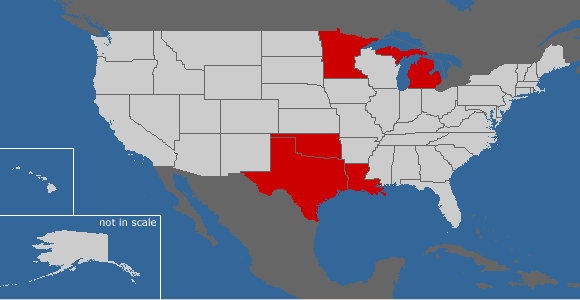
Something is amiss; perhaps it is all part of some gigantic conspiracy; we're going to have to look into this. Here's the scoop: this year's Baldrige recipients have been named. Check out this list:

  • Sunny Fresh Foods, Inc., Monticello, Minn. (manufacturing)
  • DynMcDermott Petroleum Operations, New Orleans, La. (service)
  • Park Place Lexus, Plano, Texas (small business)
  • Richland College, Dallas, Texas (education)
  • Jenks Public Schools, Jenks, Okla. (education)
  • Bronson Methodist Hospital, Kalamazoo, Mich. (health care)
My question is this: How is it all of the recipiants came from the middle of the country?

To view the complete press release detailing these role model organizations, visit the National Institute of Standards and Technology website.

Tuesday, November 08, 2005

An excellent overview of the "Q"

I know. I know. We dropped the "Q" in favor of PEC. Even so, I found this great site I wanted to recommend to everyone. I was stumbling (surfing) around the ASQ site and found this overview page that leads to pages on tools and organizational-wide approaches and four other helpful pages.

The "Q" stuff is still relevant and still helpful. Check it out.

Thursday, November 03, 2005

Looking for new travel computers


another one bites the dust
Originally uploaded by Crunchy Pickle.
We're looking for new travel computers. I put out an RFP to replace the three computers for we three Tidewater-based consultants. Here's what we're looking for.

Minimum requirements for recapped travel computers for LANT/D5/MLCA Organizational Performance Consultants:
  • Processor running at 1.3GHz or higher

  • Memory of 512 MB RAM (or more) at 533MHz (or higher)

  • 60 GB hard drive (or larger)

  • Graphics card


  • 13-inch screen (or larger)
  • Built-in speakers


  • CD-RW/DVD combo drive (or better)


  • Minimum of 3 USB 2.0 ports (more preferred)

  • Wireless 802.11 b/g capable

  • Bluetooth capable

  • Internal 56K modem

  • Ethernet/network capable

  • PC card slot


  • Operating system of Windows XP
  • Professional with Service Pack 2 with media Software to include Microsoft ® Office Professional Edition 2003 and Adobe Acrobat 6.0


  • Carrying case and AC adapter, power cord, battery pack, automobile charge adapter


  • No more than 6 pounds, complete
I know a couple of you suggested various other requirements, but we decided these were what our office needed.

I'll post results of the RFP here.

Friday, October 28, 2005

The noise of the babel


Detail van de Toren van Babel
Originally uploaded by Gryts.
Finding a way to quell the noise of the babel is probably one of the most important things a consultant can do.

Monday, October 24, 2005

Colored cards for facilitation

Some of us have been using colored 3x5 cards to help facilitate teams/groups/meetings, particularly with reaching a group decision. Here's another use.

Phone Conference this past Friday with G-CPD

Not many of us on the hook this past Friday with G-CPD. Between client work and leave, I think only half a dozen of us were available.

A couple of items of note.

First, the restructuring of the Chief of Staff's Office. G-CQM is now G-CPD, Office of Performance Management & Decision Support. The new emphasis appears to be on everything (including performance management) leaning toward supporting decision making. Decision Support is to span the various programmatic stovepipes and create systems which allow for fact-based decision making across the enterprise. From the G-CPD intranet site, it looks like there are five teams in the office:

  • Executive Support Team
  • Innovation Team
  • Performance Excellence Team
  • Business Architecture Team
  • Decision Support Team
The biz architecture team is the remments of G-833, or whatever it was; they're the RMS people, Todd Watanabe & Lori Maselli. Yes, Lori's back in the fold with us.

Captain Ray noted there are 16 FTE at G-CPD with another 23 FTE as OPCs in the field. Not a lot of FTE, particularly if our work is not coordinated, to get a lot of work done.

Second, Captain Ray talked about beefing up the Organizational Performance Consultants' tool kits; bringing all of us up to speed on four additional elements beyond the former QPC toolkit:
  • Readiness Management System
  • Unit Leadership Development Program
  • Organizational assessments
  • Category 4 issues
There was some talk about what this beefing up means; I took it to mean knowing enough about each of these to help our organizational clients with their work; bringing these tools to them so that they can manage their performance and make decisions.

Captain Ray plans on making a spin around the CG to talk to all the OPCs, their supervisors, and the chiefs-of-staff; another dog and pony tour.

Friday, October 21, 2005

OPC Roles and Responsibilities

I'd been asked by Dan to write a little roles and responsibilities for organizational performance consultants to go into a new COMDTINST that is being drafted. You can find my first run at this here. Please take a look at it and, if you have any changes or suggestions, shoot them my way.

Thanks.

Wednesday, October 12, 2005

Blaming people vs. systems or processes


living like it's golden
Originally uploaded by Quereco.
I'm trying to wheedle my way in to work with a client who has what is, I believe, a huge process problem. Question: how can I identify this problem and highlight the benefits of solid management & leadership without coming across as if I'm attacking the people involved?

Wednesday, September 28, 2005

What we are missing


Sunset Over Back Bay
Originally uploaded by Hankins.
One AM, and I'm on watch. What I'm missing is a week at the Beach with my colleagues.

Tuesday, September 13, 2005

Some summer left here in Virginia Beach

Too bad we're not going to get to enjoy it together.

Sunday, September 11, 2005

Conference canx'd


Cape Henry Lighthouse I
Originally uploaded by solanic.
I heard from Danny that our end-of-the-month conference has been cancelled. Hard to have a conference when everyone is deployed for Hurricane relief.

Well, it was a good idea.

Saturday, September 10, 2005

Not my child


virginia 2005 014
Originally uploaded by Ethereal Elle.
Let me start by saying, "This is not my child."

And let me follow on by asking, "Does it seem to you this youngster is a performance consultant in training?"

Okay, all, let's head to the beach!

Friday, September 09, 2005

Our accomodations


Beach Training
Originally uploaded by IFGA.
Thankfully, our accomodations will be better than what these Navy sailors are going to get. And we'll be close to, but not on top of, the sand.

Friday, September 02, 2005

Sunrise Over Fort Story


Sunrise Over Fort Story
Originally uploaded by Hankins.
Not far from our hotel... Who's gonna get up early enough to see the sun rise?

Thursday, September 01, 2005

Perhaps we could meet outside


_DSC2330
Originally uploaded by mikef99.
Now that I know Joy and Scott are okay, I feel we can press on in anticipation of our annual gathering. I suspect it might have some special significance.

I was thinking that perhaps instead of meeting in the room at the hotel, we could meet outside like these young business people. Oh, wait, they're not young business people; they're the executive committee of the Jay & Peter Fan Club.

Too bad Jay will not be in attendance to meet the members of the club.

Wednesday, August 31, 2005

Devastating news on the tube

Well, this post isn't going to be tongue-in-cheek or an attempt to engage you for our September get-together.

I've been surfing the net and so struck by Katrina's wrath. My thoughts and prayers are with our shipmates in the Eighth, particular our colleagues Scott and Joy. I'm guessing that Scott's condo is under water; while I never had a chance to see the inside, from the outside, it looked like quite a place. In the warehouse district. First floor. And likely under water now.

I pray for our friends and their families.

Peace.

Monday, August 29, 2005

My one real worry


Katrina in Fort Lauderdale
Originally uploaded by bfraz.
It seems -- and I am not certain the evidence actually supports this -- that the week we hold our conference is always a hurricane week. Perhaps pushing back a week will make this not so in 2005.

Anyway, my one real worry is that we get pounded by a hurricane and have to bug out. Perhaps our alternate site could be Sewanee, Tennessee?

Check out this list of storms to hit the Virginia Beach/Norfolk/Portsmouth area.

Friday, August 26, 2005

What we're missing


Here's one we're not going to be able to do... MLCLANT is hosting Chief Red Hawk on the 21st of September. He will be conducting a 90-minute session to kick off the MLC staff's leadership development program.

Red Hawk is a professional consultant and keynote speaker with 18 years of experience in the public and private sectors. He has lectured to government officials on diversity, leadership, and team building. He has written and developed motivational group programs, and facilitated organizational problem solving sessions. He has also contributed to developing training videos and training materials.

Red Hawk has extensive experience in the areas of managing diversity and cultural understanding. He has assisted in the design and implementation of system-wide programs in each of these areas. Hawk is a nationally known motivational keynote speaker on the topics of cultural diversity, issues of social change, and structural inequality. He has experience conducting complex workplace investigations, organizational problem solving, mediating employment disputes, and designing and presenting labor and employee relations training for managers and supervisors.
So, if you want to fly in a couple days early, I can get you a seat at his presentation (0900 on 21 September at the Marriott in downtown Norfolk)... and perhaps we can arrange something special, too.

Thursday, August 25, 2005

Keep the sharks in the tank, please


Aquarium20
Originally uploaded by Elfinmoon.
About three miles south of our hotel is one of the nation's finest aquarium's, the Virginia Aquarium & Marine Science Center. The name recently changed (from the Virginia Marine Science Museum) indicating its continued emphasis on the aquarium aspects of the facility. This is no hands off, staid, look-at-stuffed-and-dead-things museum.

One of the top ten most visited aquariums in the nation, the mission of the Aquarium is "To increase the public's knowledge and appreciation of Virginia's marine environment and inspire commitment to preserve its existence." How do they do it? They have:
  • 800,000 gallons of aquariums

  • Live animal habitats

  • More than 300 hands-on exhibits

  • 1/3-mile nature trail

  • ½-acre aviary

  • "Larger that life" movies on an IMAX movie screen

The Aquarium is open 0900 to 1900 daily; the cost to enter is $12 or $17 for the aquarium and the IMAX theatre.

As long as the sharks stay in the tank... perhaps we'd like to visit?

Wednesday, August 24, 2005

I live in the matrix


Matrix_B00T
Originally uploaded by matthewvelie.
Yes, I continue to post here rather than using CG Central...

If CG Central were accessible from the internet (outside the firewall)... and if it were user friendly in it's ability to post pictures and links within a text using images already on the internet... and if it didn't take so damn long to load... and if it were easy to navigate... If it was as simple to use as Yahoo or Google (which, by-the-by, it was originally billed as)... Then I'd be the first person to advocate it's use...

In the mean time... ;-)

Bring your metal detector


vab003
Originally uploaded by Emiko Hime.
Still wondering what you can do in our off-hours? Here's a great activity: we'll search for treasure along the beach.

Anyone have a metal detector they can bring?

Tuesday, August 23, 2005

Home to enlightenment

Wondering what you might be able to do in your off-time (that is, assuming that Chris and Danny let us have any down time at all)?

Did you know that Virginia Beach is home to the Association for Research and Enlightenment, the non-profit center dedicated to the life and work of Edgar Cayce, one of the most documented psychics of all time, a renowned mystic, and the "father of holistic medicine."

For forty-three years of his adult life, Edgar Cayce demonstrated the uncanny ability to put himself into some kind of self-induced sleep state by lying down on a couch, closing his eyes, and folding his hands over his stomach. This state of relaxation and meditation enabled him to place his mind in contact with all time and space. From this state he could respond to questions as diverse as, "What are the secrets of the universe?" to "How can I remove a wart?" His responses to these questions came to be called "readings" and contain insights so valuable that even to this day individuals have found practical help for everything from maintaining a well-balanced diet and improving human relationships to overcoming life-threatening illnesses and experiencing a closer walk with God.
What's this have to do with Virginia Beach? Virginia Beach held special relevance to Edgar Cayce; his visions showed Virginia Beach would survive a cataclysmic event, and the city is now the home to the Association for Research and Enlightenment.
The Association for Research and Enlightenment, Inc. (A.R.E.), is the international headquarters for the work of Edgar Cayce (1877-1945), who is considered the best documented psychic of the twentieth century. Founded in 1931, the A.R.E. consists of a community of people from all walks of life and spiritual traditions who have found meaningful and life-transformative insights from the readings of Edgar Cayce. The mission of A.R.E. is to help individuals change their lives for the better by exploring concepts and ideas found in the Cayce work.
The international headquarters of A.R.E. is in Virginia Beach, just a few (okay, about 30) blocks north of our hotel. The visitors' center hosts daily free lectures and activities. They also have a meditation garden which is open to the public.

Perhaps this warrants a field trip; we can spend time in garden, getting in touch with our inner selves.

Monday, August 22, 2005

Our conference provides a time for reflection


finding her shadow
Originally uploaded by -Angela.
Like this 18-month old examining the beach, our conference is an opportunity for us to examine our work, our relationships, our future. I'm so looking forward to it.

Of note, I'm also looking forward to spending some time with Elliot (who'll be 18-monts old also) on the beach so he can find his shadow.

The days are counting down. Please make your hotel reservations this week, if you haven't already made them.

Sunday, August 21, 2005

The fallback pool if the outside one is closed


The indoor pool
Originally uploaded by Tidewater Muse.
To those that might be worried: what if it happens to be chilly in late September or the beautiful outdoor pool is closed. Never fear. There's an indoor pool overlooking the beach. You'll have plenty of opportunity to get wet.

Saturday, August 20, 2005

No guarantees about the weather


The outdoor pool
Originally uploaded by Tidewater Muse.
Okay, I can't guarantee anything about the weather for our conference. Perhaps it will be warm and the outdoor pool will still be open. Perhaps summer will linger here in Hampton Roads, and it'll be glorious, hanging out at the pool under the palm trees.

Of course, we could always get a hurricane that week, but I'll keep my negative comments to myself.

Friday, August 19, 2005

Don't stare out the windows!


Our meeting room
Originally uploaded by Tidewater Muse.
This is our meeting room. Imagine we are gathered around the table. Imagine Danny is talking, "Blah, blah, blah, blah." Imagine the view out the window. Imagine how you're seeing Danny's mouth move, but the words aren't registering. Imagine ducking out the door on the break. Imagine dashing across the boardwalk & racing through the sand to the water.

Ah, I can hardly wait.

Thursday, August 18, 2005

From this past weekend's NY Times

And you thought we're just heading to po-dunk USA? Well, this past Sunday's New York Times' travel section had a write-up on good eats in Virginia Beach! Wrote Mimi Sheraton,

Beautiful eating, however, is the lure for me whenever I am beside the Chesapeake shores, in my experience the source of the world 's pearliest and most toothsome crab meat. That, after having sampled such highly touted specimens as Maine's peekytoe, the West Coast's Dungeness, Alaska's kings and snows, Florida's stone crabs (which I knew as Morro crabs in pre-Castro Cuba) and the crustacean delights of Venice, Louisiana, Kamchatka and Shanghai. As with lobsters when I am in Maine and oysters in Brittany, it was crabs that I built my daily meals on a recent five-day quest in Virginia Beach.

Crustaceans aside, this entertaining seaside city is a repository of some of our country's earliest history as well as a relaxed beach-and-boardwalk resort, stylistically and economically hospitable to families. My goal, however, was to have as much of that silky, sweetly briny meat as possible, in the simplest and most classic preparations - steamed whole and spicy or mounded into puffy, meaty crab cakes, or as the tiny, supple soft-shells, preferably sautéed or lightly fried. The only noncrab tradition that fits such feasting is Hatteras clam chowder, the clear, clam-broth-based soup of the Outer Banks, modified neither with milk nor tomato and laden with clams, celery, onion and, usually, carrots, all cut in varying sizes from the chunkiest to the finely minced.
We'll have to see what we can do.

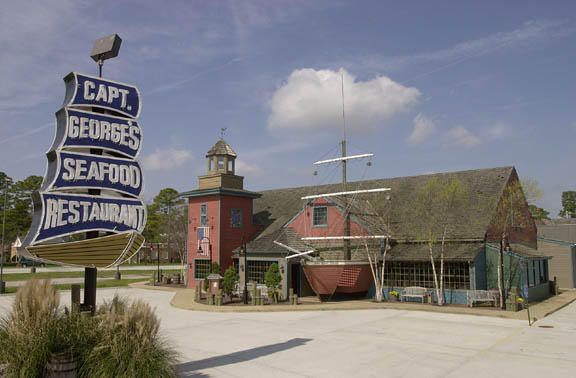
I'd been thinking maybe Captain George's, a seafood buffet place. Less expensive, perhaps, than Mimi's tastes. Here's what the Virginia Beach Convention & Visitors Bureau has to say about George:
Only one place has truly captured the essence of the oceans. Captain George’s legendary buffet has been heralded up and down the East Coast as one of the best collections of fresh seafood and regional cuisine available. With over 70 items, fresh seafood cooked every way imaginable, traditional Greek dishes and desserts, beef and pasta dishes, and fresh vegetables are just a walk past the array of incredible buffet items will ensure a return visit.

Located in rural Pungo, south of the resort area, Captain George’s has long been a place to bring friends all of your friends and kick back in a casually elegant dining room. You can enjoy the fare from the buffet, order smooth and icy fruit beverages from the bar, or select a vintage from our extensive wine list.
Get ready to eat, eh?

Check this hotel out, folks

Here's our home for the last week of September!

Please make certain you make your reservations at the correct Marriott Courtyard (there are two in Virginia Beach). We're at Courtyard Virginia Beach Oceanfront/North 37th Street. The address is 3737 Atlantic Ave, right on the Oceanfront. Make your reservations by calling 757-437-0098, and be certain to tell them you're with the Coast Guard Performance Excellence Conference.

Get psyched; we're going to have an excellent conference.

Saturday, August 13, 2005

Our annual conference is less than two months away!


DSC_0077
Originally uploaded by CokeintheCan.
And even in late September, the water will be warm enough to swim. Ought to be beautiful; and the surf will be right out the door of the conference room!

Tuesday, June 07, 2005

I seem to have missed something

Ok, so in Santa Clara, we all agreed to take on this project of creating a guide for the Performance Excellence Criteria. Being all about excellence, I, of course, have forgotten what I'm due to complete.

Ain't that just about par for the course?

Monday, May 23, 2005

News from the home office: FY06 Performance Excellence classes by the Leadership Development Center

The home office has tentatively set the following training dates for FY06:

CPEC (proposed)
03-04 Oct 2005, New London, CT
06-07 Oct 2005, D9 Cleveland, OH
13-14 Oct 2005, D14 Honolulu, HI
24-25 Oct 2005, D11/PAC Oakland, CA
26-28 Oct 2005, D5/LANT Portsmouth, VA
14-15 Nov 2005, D1 Boston
14-15 Nov 2005, D13 Seattle, WA
17-18 Nov 2005, HQ Ballston, VA
17-18 Nov 2005, D17 Kodiak, AK
28-29 Nov 2005, D7 Miami, FL
01-02 Dec 2005, D8 New Orleans. LA

CQA Examiners (proposed)
23-27 Jan 2006, New London, CT
30 Jan - 03 Feb, 2006, Oakland, CA
06-10 Feb 2006, New London, CT
13-17 Feb 2006, Ballston, VA

QPC basic (proposed)
14-25 August 2006, New London, CT


Team Leader & Facilitator (scheduled so far)
17-21 October 2005, ISC San Pedro, CA
31 Oct - 04 Nov 2005, Norfolk, VA

Monday, October 04, 2004

Upcoming dates...

Stole these from George's newsletter...


CPEC Dates    Location
----------    --------
07-08 Oct      D8
18-19 Oct      D13
21-22 Oct      D11 / PAC
09-10 Nov      D1
15-16 Nov      D7
18-19 Nov      HQ
01-02 Dec      D17
01-02 Dec      CGA
07-08 Dec      D9
09-10 Dec      D5 / LANT / MLCA
13-14 Dec      D14

CQA Training    Location
------------    --------
03-07 Jan      New London
10-14 Jan      Washington, DC
24-28 Jan      New London
31Jan-04 Feb      Alameda


18-21 Jan LANT Mini-Conference @ Atlanta

Tuesday, September 21, 2004

Hot Job Opportunity in Norfolk... one of us ought to nail this one!

Hey, guys, this one is too good to pass up:


MANAGEMENT SPECIALIST
GG-0343 -13
$69,762 - $90,692 per Annum
Announcement Number: NE4-0343-13-CIPO-0211

Open Date: 09/15/2004
Closing Date: 09/29/2004

Salary Range
$69,762 - $90,692 per Annum

Job Location(s)
Norfolk, VA

About the Job

This position is located at Joint Forces Intelligence Command, Plans and Programs Directorate (DP), Requirements and Program Management (DP1), Norfolk, VA.

Serves as a Team Leader.

With minimal to no supervision, develops and maintains a Performance Management and the Balanced Scorecard program throughout the Plans and Programs Directorate and the Command.

Develops and implements a program to provide ongoing monitoring and reporting of, but not limited to, operational performance, cost and utilization, labor productivity, major initiatives in alignment with strategic direction, outcomes, quality and other key metrics associated with alignment and accomplishment of directorate, division, branch, individual and command-wide missions, functions, processes, products, and services.

Responsible for overall implementation of the balanced scorecard at the command-wide level and then cascading the scorecard down from the command level, through the directorate and division levels, down to the individual level, working with all personnel in the command to understand and fully implement the program.

This effort includes training command personnel in the use, effectiveness, and application of the Balanced Scorecard or other performance management techniques.

This position will be instrumental in working with individuals, groups, and cross-matrixed teams to improve overall performance and mission accomplishment.

This position will work specifically with other DP1 requirements managers/analysts to develop specific performance metrics associated with transformation and future intelligence requirements accomplishment.

Assist the strategic planners with strategy mapping and strategic objectives development and implementation.
This position must have a total understanding of the intelligence cycle and be fully conversant and experienced in the full spectrum of Intelligence functional areas and methodologies so the performance management and improvements will have a positive effect on intelligence transformation.

Proficient and experienced oral and verbal presentation skill are a must.

The Team Leader will ensure the other performance management analysts exhibit a proactive approach to the development, implementation and training of command personnel in all aspects of metrics, accountability, performance improvement, Balanced Scorecard, and performance management. Other methodologies, such as Six Sigma, and CMMI should be incorporated as required. Other duties as assigned.

Who May Apply
All Qualified Candidates Nationwide

See Navy Jobs to apply; search by Announcement Number.

Friday, August 27, 2004

Book recommendation: The power of the matrix

Recommended reading: The Power of the 2 x 2 Matrix : Using 2x2 Thinking to Solve Business Problems and Make Better Decisions. Hopefully we'll all get copies in September at the conference. If not, worth spending your own funds to get a copy.

Richter and I have never met a model we didn't like... ;-)

Thursday, August 26, 2004

Make meetings great!

Well, folks, here I am attending QPC Basic. Danny and Chris decided I needed a little re-training, so they sent me back here to the LDC. I'm not sure how they figured that would help as it's pretty darn difficult to teach an old dog new tricks. But, nonetheless, here I am.

In truth, this has been a good two weeks, allowing me to refocus on what I and we are doing; it's also given me an opportunity to meet some new QPCs and some "quality professionals." Last week Charlie had me on the podium covering some consulting basics such as aligning and consulting, so I got a chance to poison the class. ;-)

I have picked up a slew of stuff, including this little gem: Let's make meetings GREAT!

  • Goals should be smart
  • Roles & rules
  • Expectations
  • Agenda
  • Time
Nifty, eh? I certainly thought so.

That's about it for now. See y'all in Portsmouth next month! If you haven't made your reservations... well, you might be out of luck!

Tuesday, June 22, 2004

Check this out...

Well, fellow performance consultants... wondering what life might bring after a tour or two as a performance consultant... check this out!

Friday, December 12, 2003

What are we truly about?

I learned today that my colleague was "let go" earlier this week. Currently serving as a consultant in southern Florida, he was told yesterday that his employment was being terminated at the close of business yesterdy. I am devastated? An excellent consultant, a knowledgeable consultant, he helped our organization in a myriad of ways. Let go not for ethical breach, but for some nearly non-descript reason, he's out on the street.

My question I'll post here (and I'll vent at my Tidewater Musings) is this: What are we really about? Our we about getting and keeping and developing excellence? Or is that something we just claim to be about, when we are really about pettiness and power and fear?

Michael, perhaps you are correct (see his "Conspiracy Theories Abound" posting below... from 11/06/2003)

Friday, November 21, 2003

a rose by any other name is still a rose

Received from Dorothy W:

I read a couple of your later entries on your blog regarding the decline in QPC references and the Leadership initiative message from the Area Commander. Although I am new to the organization and the position, I am very familiar with the "quality movement." As a "newbie" with the Coast Guard, here are my thoughts on this:

One of the key outcomes for QPCs, as I see it, is to make the application of "best methods" a part of everyday management in the Coast Guard. I do not necessarily see that as a continuous use of the terms and program we are a part of. As more and more units use the criteria as a tool and apply the core principles of the criteria, the "program" becomes less important. Whether it is called ethical leadership, caring management, passionate and compassionate commanders, assessments of readiness, teamwork, listening to your people, taking care of "the little things," thinking in terms of the "what if type scenario," or "individual and team effectiveness," each application of these principles is an application of quality criteria in another dress. I do not see a decline in the need for QPCs, but an increase in demand for teaching and providing the techniques to make this happen. This is a good thing.

Because "Quality" is an '80's word and TQM miss-application has left some people with a negative impression of the word, I am not overly concerned about the lack of inclusion of these terms in any message dealing with Leadership. I certainly don't want to see us slip back into using "management" as our goal, but if that term can grow to encompass true Leadership and quality management, then we will have succeeded in our mission. After all, "a rose by any other name is still a rose."

Thursday, November 20, 2003

Blogging at work...

Take heart, dear fellow PEC people: it doesn't have to be you getting canned for blogging... Let's keep it work focused on helping encourage performance excellence... For my other musings, well, you'll have to look elsewhere...

Friday, November 14, 2003

A Process for CPEC-Based consulting, Cat 2 & 4 (sort'a)

This is what I did today with the LANT-side ISC Commanding Officers and the MLCA Commander & Deputy Commander...

Moving Beyond Measuring for Measurement’s Sake – A Model of Outcome-based Measures
(a facilitated exercise)

As we continue to implement the Coast Guard’s management framework, as specified in the Commandant’s Performance Excellence Criteria (COMDTPUB P5224.2C dated 31 October 2003), we are challenged to create systems which allow us to make fact-based decisions and to gauge our performance toward meeting forward-view objectives. Measurement helps us. We do not advocate measurement for measurement’s sake, but rather a balanced approach to measurement. We measure so we can manage, and we measure so we can gauge our performance against a goal. We do not measure just to measure.

The Performance Excellence Criteria asks us to consider how we select, collect, align, and integrate data and information for tracking overall organizational performance. The Criteria expects senior leaders to review organizational performance and capabilities, to assess organizational success and progress to goals, and to regularly review key performance measures.

In this session, we will begin to use an outcome-based methodology to determine key performance measures within programs housed & delivered at Integrated Support Commands. The methodology we’ll use today is in alignment with the Balanced Scorecard methodology and the Coast Guard’s 2-4-7 methodology. And of course, this methodology supports the Criteria.

Each CO will be working in a specific program area or ISC functional area.

· Industrial
· Work-Life
· Reserve Management
· PERSRU Functions
· Surge Staffing
· Finance

Here is the mental model of what we’ll be doing:

OUTCOME (DESIRED END STATE) ---> GOALS ---> MEASURES ---> INITIATIVES

A couple of important notes about this paradigm. First, we are starting from the outcome or desired state. Often when people in the Coast Guard talk about measurement, they start with measurement without having it tied to an outcome or goal or objective or whatever. Second, this model serves the senior leadership of the organization. Senior leaders determine the outcomes and set the goals and, perhaps, set the measures. Senior leaders don’t dictate the initiatives; the individual manager and the workers figure out how what tasks and initiatives need to be done to drive the measures to get to the goals to create the outcome.

We will also be looking at those things we need to do internally in order to succeed. The mental model for these things looks remarkably similar:

CRITICAL SUCCESS FACTOR ---> GOALS ---> MEASURES ---> INITIATIVES


Name of program or area of emphasis:

Now, think about the customers in that particular program. Customers, as you know, are the folks who get products and services.

Who are this program’s customers?


List products and services customers of this program receive.


Now we begin to move to identifying the outcomes or desired states we are trying to create for the customers of this particular program. These are not the products. For instance, the desired outcome Kia Motors strives to create “affordable, personal transportation.” The local regional critical incident stress management team is creating an outcome of “emergency services workers who deal with traumatic stress in healthy ways.” A church might define one of their outcomes as “souls bound for heaven;” a high school might define one of their outcomes as “graduates who can function in a changing, information-charged, technological world.”

What are the outcomes, the desired end states, the program is working to create? Some of these outcomes will be for customers; other outcomes might be for other key stakeholders (or “broker customers” in some models).

List outcomes (or key desired end states) this program is trying to create.


It’s almost impossible to focus on more than one or two things at a time. We need to focus on the critical few. From the above list, what are the one or two most important outcomes? Highlight or circle them.

Think about how your ISC, and other ISC’s, goes about creating the products and services which create the customer/stakeholder outcomes. There are a few things that the individual producers & the ISC must do to in order to create those outcomes. If we don’t do these things, we will fail. For this exercise, we’ll call them “critical success factors.” These are things, inside the walls of the ISC or the MLCA community or the program stove pipe, that we must do successfully in order to succeed. If we don’t do them, we will fail.

List the critical success factors here.


Again, we can’t focus on more than one or two things. What are the top one or two critical success factors. Truly, if we fail at these, we fail in creating the outcomes.

Now we begin to think about goals. Some goals will flow easier than others. For each outcome or critical success factor will develop goals. The goals will help us know whether or not we are creating the outcomes we want to create or meeting the critical success factors we’ve identified.

A goal can be measured. For instance, a goal for Kia might have to do with units sold or market share: Kia Motors will have 12% of the under $17,000 auto market by 2005. A CISM team might have a goal related to employee turnover: Our agency has an employee retention rate of 98%. The goal is not necessarily the outcome; it’s a goal toward the outcome.

For each outcome and critical success factor, brainstorm several goals. Write those goals here:

Now, go back to the list of goals, and identify the top two for each outcome and the top two for each critical success factor.

We now get to the measures portion of this . Until now, we haven’t been discussing measures. Measures are, quite frankly, secondary to the outcomes, critical success factors, and goals.

There are only two reasons to measure: to make better management decisions and to gauge progress toward a goal. Certainly, an organization might have hundreds of measures. But the bulk of those measures are not tracked at the senior leadership levels of the organization. They are tracked at the worker and supervisory and lower management levels. Does the president of Kia care how long Joe takes for lunch? Not likely. Does Joe’s supervisor? Sure.

So, we’re not going to capture here all the measures. We are concerned only with the measures which are indicators of attainment of the goal.

Below, please write your top outcome and critical success factor. Now we move to measures. Measures in this model are nothing more than indicators of performance toward the goal; in addition, the measures will help us manage (a part of this “management” key is the measures will drive action). List some possible measures or indicators for each goal.

Goals & Measures:

The measures may be directly linked to the goals, or they may just be indicators of performance to the goal.

The next step after settling on measures is to determine initiatives which will drive the measures. Initiatives should generally be completed not by the senior leader but by the manager responsible for the function with input from the leader and the workers.

I have a document which has an additional example. If you want it, please zip me an email or get in touch with Renee who has the document also.

Thursday, November 06, 2003

CPC Workbooks for participants

I'm having some difficult getting a handle on what we provide to the CPC participants. I'd like us to have an enterprise-wide booklet we use, some sort of standardized workbook, with tabs, for the CPC... I'd love to be able to get some GPO printed/bound process booklets that we can all use. I have a thing (that needs improvement) that I've been using; this is what's in it:

    UPF
    ASSESSMENT OVERVIEW
    -- Objective page
    -- Ground rules & expectations
    -- Agenda
    -- Processing the Category
    -- Cat pre-work
    -- Cat post-work
    -- Criteria Core Principles Concepts
    -- Definitions
    -- Systemic Levels
    -- Results Matrix
    DEATH BY POWERPOINT
    -- 3 slides per page view of the official intro ppt
    RELATIONSHIP MODEL
    CRITERIA PERF EXCELLENCE

I'd like to be able to call somewhere and say "please send 18 books to Unit Bumbleshort; I have a CPC there in 2 weeks."

A partnership between the LDC (developer of the book) and the INSTITUTE (book fulfillment)?

Thoughts?

Thursday, October 30, 2003

Thoughts on leadership and the Performance Excellence Criteria

In reading the below, I was struck by the obvious absence of any reference to the Commandant's Performance Excellence Criteria, the Coast Guard's management framework which, in no uncertain terms, delineates the criteria for excellence in leadership in our organization (see Category 1). I am disappointed in that (a) who ever chopped on this message did not have the wherewithal to add the CPEC to the laundry list of recommended readings and references and (b) the Commander of Atlantic Area didn't himself see the link between leadership and the Coast Guard's management framework.

Either we are going to approach the issue of leadership and management systematically, or we're not. Either we have a management framework -- which, again, delineates the requirements for a leadership system -- or we don't. And, if we don't have a system and we don't have a framework, then my job with this organization is worthless; I may as well not even show up for work.

R 241621Z OCT 03 ZUI ASN-A02297000011
FM COMLANTAREA COGARD PORTSMOUTH VA//A//
TO ALLCOGARD LANT
INFO COMDT COGARD WASHINGTON DC//G-CV/G-O/G-M//
COMPACAREA COGARD ALAMEDA CA//P/PO/PM//
COMLANTFLT NORFOLK VA//N00/N3/N9/N3CG//
COMSECONDFLT//J00//
CDR USNORTHCOM//J00/J3//
JFHQ HLS NORFOLK VA
HQ USNORTHCOM//J00/J3/J34//
COGARD ACADEMY NEW LONDON CT//LDC//
BT
UNCLAS //N16000//
SUBJ: OPERATIONAL COMMANDER'S INTENT - THOUGHTS ON LEADERSHIP,
ETHICS AND CHARACTER IN THESE TIMES OF CHANGE, CHALLENGE AND
JUNIORITY
1. SINCE ASSUMING COMMAND OF COAST GUARD ATLANTIC AREA, I
HAVE TRANSMITTED SIX PREVIOUS COMMANDERS INTENT MESSAGES TO
COMMUNICATE WITH ALL MEMBERS IN THE CHAIN OF COMMAND ON SUBJECTS
RANGING FROM RISK ASSESSMENT TO SPECIAL INCIDENT REPORTING. THIS
MESSAGE ADDRESSES A SLIGHTLY DIFFERENT SUBJECT, YET ONE THAT I
FEEL VERY STRONGLY ABOUT - LEADERSHIP.
2. CRISES, SUCH AS 9-11, COUPLED WITH AN INCREASE IN
OPERATIONS, BOTH LOCALLY AND OVERSEAS HAVE HELPED HIGHLIGHT
LEADERS. READ SOME OF THE STORIES OF BRAVERY, COURAGE AND UNMATCHED
INGENUITY THAT CAPTURED THE COAST GUARD'S RESPONSE TO 9-11 AND ALL
THE ACTIVITIES AND OPERATIONS THAT FOLLOWED. YOU QUICKLY APPRECIATE
THAT OUR SERVICE PERFORMED AT A LEVEL EPITOMIZING SELFLESS SERVICE,
THE COAST GUARD'S CORE VALUES AND THE HIGHEST FORMS OF CHARACTER.
THE RECENTLY PUBLISHED U.S. NAVAL INSTITUTE BOOK ENTITLED,
"CHARACTER IN ACTION: THE U.S. COAST ON LEADERSHIP," BY DONALD T.
PHILLIPS AND FORMER COMMANDANT ADMIRAL JIM LOY, FURTHER CAPTURED
DOZENS OF STORIES AND ANECDOTES ABOUT OUR SERVICE AND ITS TRADITION
OF HEROISM AND RISING TO THE CALL OF DUTY - WHATEVER THE MISSION.
OUR SERVICE'S CORE VALUES OF HONOR, RESPECT AND DEVOTION TO DUTY
REFLECT THIS TRADITION AND THE INDIVIDUALS WHO MAKE UP OUR SERVICE.
3. THE WHOLE SUBJECT OF LEADERSHIP HAS BEEN DISCUSSED IN NUMEROUS
FORUMS, SEMINARS AND THINK TANKS. IT HAS BEEN WRITTEN ABOUT SINCE
THE DAWN OF RECORDED HISTORY. I WANT TO FOCUS ON FOUR KEY ISSUES
THAT ARE ESPECIALLY IMPORTANT TO ME, WHILE KEEPING IN MIND OUR
SERVICES' LEADERSHIP COMPETENCIES OF SELF, WORKING WITH OTHERS, AND
PERFORMANCE. SPECIFICALLY;
A. CREATE A COMMAND CLIMATE OF TRUST
B. IMPORTANCE OF SELF-STUDY AND PROFESSIONAL ETHICS
C. WALK THE DECK PLATES AND BUILD UP YOUR PEOPLE
D. NEVER FORGET THE LITTLE THINGS
4. CREATE A CLIMATE OF TRUST: MOTIVATIONAL SPEAKER MIKE
ABRASHOFF, IN HIS BOOK "IT'S YOUR SHIP," WROTE THAT "ONCE LEADERS
HAVE SET THE TERMS OF THE NEW SOCIAL CONTRACT WITH THEIR WORKERS,
THEY NEED TO HAVE THE COURAGE OF THEIR CONVICTIONS. THE BEST WAY TO
KEEP A SHIP - OR ANY OTHER ORGANIZATION - ON COURSE FOR SUCCESS IS
TO GIVE THE TROOPS ALL THE RESPONSIBILITY THEY CAN HANDLE AND STAND
BACK. TRUST IS A HUMAN MARVEL - IT NOT ONLY SUSTAINS THE SOCIAL
CONTRACT, IT'S THE GROWTH HORMONE THAT TURNS GREEN SAILORS INTO
SEASONED SHIPMATES AND TROUBLED COMPANIES INTO DYNAMIC
COMPETITORS." HOWEVER, YOU NEED TO HOLD INDIVIDUALS AND
ORGANIZATIONS ACCOUNTABLE, BUT GIVE THEM FREEDOM TO PERFORM THEIR
ASSIGNED TASKS.
A. HOW CAN TRUST BE ENCOURAGED? FIRST, BE AN ACTIVE
LISTENER. THE TERM IS OVER USED BUT THE MESSAGE IS IMPORTANT.
ENCOURAGE PEOPLE TO SPEAK UP, INNOVATION SHOULD BE REWARDED. ASK
RHETORICAL QUESTIONS - THIS WILL KEEP THE PERSON YOU ARE SPEAKING
WITH ACTIVE AND THINKING. ENCOURAGE PASSION AND COMPASSION, THE
MORE PERSONAL INTEREST YOU CAN PROJECT AS A LEADER, THE MORE TRUST
WILL BE DEVELOPED.
B. SECOND, DON'T SHOOT THE MESSENGER. IT IS CRITICAL THAT LEADERS
DON'T CRITICIZE OR "SHOOT" THE PERSON THAT BRINGS THEM BAD NEWS.
FROM THE COMMAND CENTER CONTROLLER, TO THE ON-SCENE MARINE
INSPECTOR, BAD NEWS MUST BE REPORTED. A TRUE LEADER LISTENS
ACTIVELY, ASKS QUESTIONS AND ENCOURAGES ADDITIONAL INFORMATION. AS
A LEADER YOU NEED TO HEAR ABOUT PROBLEMS BEFORE THEY GET OUT OF
HAND. YOU NEED TO KNOW WHO IS DOING WHAT. YOU NEED TO SEPARATE THE
SIZZLE FROM THE STEAK AND KNOW THE REAL STATUS. THIS IS ACHIEVED,
IN PART, BY ENCOURAGING YOUR PEOPLE TO REPORT WHAT IS REALLY
OCCURING OUT THERE. THIS APPROACH ENSURES AN ACCURATE ASSESSMENT OF
READINESS. WE ALL NEED TO LET THE EMPEROR KNOW WHETHER HE HAS
CLOTHES ON OR NOT.
C. FINALLY, PROMOTE INTERACTION WITHIN DEPARTMENTS, DIVISIONS AND
THE INTERAGENCY. THIS WILL BUILD A FOUNDATION FOR STEWARDSHIP. TOO
OFTEN WE GET SO WRAPPED UP IN OUR DAY-TO-DAY JOBS THAT WE FORGET
THAT SEVERAL DIFFERENT GROUPS ARE WORKING TOWARDS THE SAME GOAL.
UNITS, OR DIVISIONS WITHIN LARGE COMMANDS, SHOULD ENCOURAGE CROSS-
TRAINING AND PROMOTE LEARNING FROM EACH OTHER. ONE EXAMPLE IS "O"
AND "M". THE MISSIONS OF THESE TWO BRANCHES GROW CLOSER DAILY, AS
DOES THE NEED TO BUILD TRUST AND ENCOURAGE ESPRIT DE CORPS. AS THE
BOOK "CHARACTER IN ACTION" SUGGESTS, "HAVE YOUR ORGANIZATION
FUNCTION IN A TEAM ENVIRONMENT. PEOPLE WILL BE MORE PRODUCTIVE BY
FAR. THEY WILL ALSO BE HAPPIER."
5. SELF-STUDY AND ETHICS. GOOD LEADERS DEVELOP THROUGH A NEVER
ENDING PROCESS OF SELF STUDY, EDUCATION, TRAINING AND EXPERIENCE.
THIS INCLUDES AN UNDERSTANDING OF THE UNIQUE NATURE OF OUR
PROFESSION AND THE ETHICS THAT GOVERN IT. I ENCOURAGE EVERY MEMBER
OF ATLANTIC AREA TO MAKE THE MOST OF YOUR TIME IN THE COAST GUARD.
EDUCATIONAL BENEFITS ARE ONE OF THE BEST PERKS OF SERVICE. NEW
PROGRAMS LIKE "COURSE IN A BAG" BRING THE CLASSROOM TO DEPLOYED
CUTTERS, WHILE THE INTERNET ALLOWS REMOTE STATIONS AND DETACHMENTS
THE CHANCE TO COMPLETE PROGRAMS UP THROUGH PHD.
A. LEADERS, AT ALL LEVELS, BOTH ACTIVE, RESERVE OR CIVILIANS, NEED
TO EMBRACE PROFESSIONAL MILITARY EDUCATION AND THE STUDY OF
MILITARY ETHICS AS PART OF THE DEVELOPMENT OF THEIR PEOPLE. HERE AT
LANTAREA, THE NUMBER OF STAFF MEMBERS ENROLLED IN PROGRAMS LIKE THE
MARINE CORPS COMMAND AND STAFF COLLEGE, AND NAVAL WAR COLLEGE
DISTANCE AND SEMINAR PROGRAMS HAVE INCREASED THREE HUNDRED PERCENT
IN THREE YEARS. DR GEORGE YACUS, OF THE AR STAFF, HAS BEEN A
PIONEER IN ESTABLISHING AND THEN RUNNING A STAFF-WIDE SEMINAR
PROGRAM FOCUSING ON LEADERSHIP. GOOD LEADERS UNDERSTAND THE
IMPORTANCE OF EDUCATION, WHICH CAN COME IN MANY FORMS, AS A KEY
PART OF THEIR PERSONAL AND PROFESSIONAL DEVELOPMENT. ONE WAY TO
ENHANCE YOUR PROFESSIONAL DEVELOPMENT IS TO GO TO THE COMDT'S
LEADERSHIP WEBSITE (WWW.USCG.MIL/LEADERSHIP) AND PATH TO THE
COMMANDANT'S READING LIST (FORMALLY CALLED THE "COAST GUARD'S
PROFESSIONAL READING LIST). USING THIS WEB SITE, REGARDLESS OF
POSITION, MILITARY OR CIVILIAN, OFFICER OR ENLISTED, APPROPRIATE
SELECTIONS ARE PROVIDED.
B. THE STUDY OF ETHICS IS CRITICALLY IMPORTANT. AS PUBLIC
SERVANTS WE ARE CHARGED WITH BEING THE BEST POSSIBLE STEWARDS OF
THE PUBLIC TRUST. THIS MEANS OUR ACTIONS AND WORDS MUST BE BEYOND
REPROACH. AS A LEADER, HAVE YOU BROUGHT YOUR CREW TOGETHER AND
DISCUSSED ETHICS? IF YOU HAVEN'T, YOU SHOULD CONSIDER IT. THERE ARE
MANY GOOD ARTICLES ON ETHICS WRITTEN, FOR EXAMPLE, BY TRUE AMERICAN
HEROS LIKE MEDAL OF HONOR WINNER VADM JAMES STOCKDALE, THAT WOULD
HELP FACILITATE A GOOD DISCUSSION. ETHICS IS AN IMPORTANT PART OF
OUR COAST GUARD MORAL FIBER.
6. TAKE THE TIME TO WALK THE DECK PLATES. JOC ALEX HALEY ONCE SAID
IN A SPEECH ON LEADERSHIP, "FIND THE GOOD." IT'S EASY…AND I
COULDN'T AGREE MORE. ONE OF THE GREATEST JOYS I HAD IN COMMAND WAS
GETTING UP EARLY OR STAYING UP LATE AND "WALKING THE CUTTER." I GOT
TO KNOW MY CREW ON A PERSONAL LEVEL BY JUST WALKING THE DECK PLATES
AND TALKING WITH THEM.
A. WHEN YOU GET OUT AND WALK YOUR UNIT, DO IT WITH AN OPEN MIND TO
SUGGESTIONS. AS PHILLIPS AND LOY SUGGEST, "INVOLVE OTHERS. STUDY
THE MERITS, AND IF THE IDEA PASSES MUSTER CREATE A PLAN WITH VISION
AND GOALS."
B. BY GETTING AROUND YOUR MARINE SAFETY OFFICE OR THE CUTTER, NOT
ONLY DO YOU FIND THE GOOD - YOU FIND THE PROBLEMS. TAKE ACTIONS ON
BOTH FRONTS. YOU GAIN SITUATIONAL AWARENESS OF THE PEOPLE, SYSTEMS
AND EVENTS AROUND YOU. WITH UNDERSTANDING AND KNOWLEDGE COMES
EMPOWERMENT.
7. NEVER FORGET THE LITTLE THINGS: ALL OF US ARE INCREDIBLY BUSY.
IT DOESN'T MATTER IF YOU ARE ON THE OLE STAFF IN D1, STATIONED ON
THE GREAT LAKES, A WESTERN RIVER BUOY TENDER, A SAR STATION IN
TEXAS, A 110' IN KEY WEST, OR NESU CHARLESTOWN; LEADERS NEED TO
MAKE THE TIME TO PRAISE AND RECOGNIZE THEIR CREWS.
A. THE BOOK "THE ONE MINUTE MANAGER," BY KENNETH BLANCHARDT AND
SPENCER JOHNSON, RECOMMENDS THAT INDIVIDUALS RECEIVE PRAISE, OR
FEEDBACK IN A TIMELY FASHION. IN SHORT, FIND THE GOOD AND PRAISE
IT, FIND THE BAD AND FIX IT. I USE THIS PHILOSOPHY DAILY.
B. WE ALSO NEED TO RECOGNIZE THOSE WHO SUPPORT THE COAST GUARD IN
THE COMMUNITY. HAS YOUR COMMAND EVER WRITTEN UP A SWIVEL SHOT AWARD
FOR CONSIDERATION? WE HAVE A WIDE RANGE OF PROGRAMS TO REWARD
THOSE WHO HELP US. TAKE THE TIME TO GIVE CREDIT WHERE CREDIT IS
DUE.
C. OUR NATION'S CURRENT SECRETARY OF STATE, RETIRED GENERAL COLIN
POWELL, HAS A SERIES OF LEADERSHIP GUIDELINES. ONE STATES, "NEVER
NEGLECT THE DETAILS. WHEN EVERYONE'S MIND IS DULLED OR DISTRACTED
THE LEADER MUST BE DOUBLY VIGILANT." GENERAL POWELL'S ADVICE IS
INCREDIBLY APPROPRIATE TO US ALL IN OCTOBER 2003.
D. IF YOU ARE IN COMMAND OF AN 87' PATROL BOAT, A COXSWAIN OF A
NEW HS BOAT OR A LEAD MARINE INSPECTOR DEEP WITHIN THE ENGINE ROOM
OF A CRUISE SHIP WITH OPERATING MACHINERY ALL AROUND YOU, YOUR MIND
NEEDS TO BE FOCUSED ON NOT ONLY THE "BIG PICTURE" BUT ALSO THE
DETAILS. SURE, YOU MAY HAVE AN XO AND ENTIRE CREW TO HELP YOU, ALL
WELL TRAINED PROFESSIONALS, BUT AS A LEADER, THE NEED TO KEEP TRACK
OF THE DETAILS SITS SQUARELY ON YOUR SHOULDERS. YOU HAVE TO THINK
BEYOND "LIFELINES" TO THE "WHAT IF TYPE SCENARIO."
E. USE TEAM COORDINATION TRAINING (TCT), A PROGRAM THAT REDUCES
THE PROBABILITY FOR HUMAN ERROR BY INCREASING INDIVIDUAL AND TEAM
EFFECTIVENESS, BY DISCUSSING THESE CONCERNS WELL BEFORE A SITUATION
OCCURS. DISCUSSING SCENARIOS WITH YOUR CREW WILL PAY HUGE DIVIDENDS
IN THE FUTURE. (DETAILS ON TCT ARE FOUND IN COMDTINST 1541.1).
8. LEADERSHIP IS SOMETHING ALL OF US NEED TO WORK ON EVERY DAY.
EVEN IF YOU ARE NOT IN "COMMAND," EVERY COAST GUARD MEMBER IS A
LEADER. WITH THIS IN MIND I AM DIRECTING THAT ALL LEADERS,
OFFICER, ENLISTED AND CIVILIAN, USE THIS MESSAGE AS A FOUNDATION TO
DISCUSS THE IDEAS EXPRESSED ABOVE WITH YOUR SUBORDINATES AND
SHIPMATES BY 30JAN04. TAKE AN HOUR, EVEN USING A "BROWN BAG
LUNCH," TO TALK ABOUT LEADERSHIP AND OUR CORE VALUES OF HONOR,
RESPECT AND DEVOTION TO DUTY. ENCOURAGE DISCUSSION AND DEBATE, GROW
FROM THE EXPERIENCE. THOSE OF YOU FAMILIAR WITH MY STYLE OF
LEADERSHIP KNOW THAT AS I WALK THE DECKPLATES OF LANT AREA, I'LL BE
ASKING HOW THIS IS GOING.
9. CONSIDER ONE FINAL THOUGHT. GENERAL GEORGE PATTON WAS CREDITED
AS SAYING, "ACCEPT THE CHALLENGES SO THAT YOU CAN FEEL THE
EXHILIRATION OF VICTORY." THESE ARE WORDS EACH OF US CAN LIVE BY.
10. REQUEST WIDEST POSSIBLE DISSEMINATION. INTERNET RELEASE
AUTHORIZED.
11. VICE ADMIRAL JIM HULL SENDS.
BT
NNNN

Tuesday, October 21, 2003

Using the CPC to drive an understanding of the CPEC

Wrapping up a CPC here in Cleveland (drafting the final report... okay, procrastinating right now).

As we work to inculcate the CPEC into the Coast Guard, a couple of thoughts/questions.

1. With the merge of o & m upon us, and the integration of logistics support running not far behind, and the number-staff configuration waiting in the wings... has any senior leader used the CPEC to ask the right questions? If the CPEC is, indeed, our management framework, wouldn't we use it to ask questions and help us make management decisions? What can we do to get decision makers to ask the right questions?

2. When doing a CPC... how much consulting & advice giving is appropriate to give? I found myself today providing consulting advice.

Question from client: Er, how do I do strategic planning appropriate to my unit?

Stinson's answer: Er, try this model...

A. What are the desired outcomes you're trying to create for your customers and key stakeholders?

B. For that outcome, what is an associated goal?

C. What indicators or measures will tell you how you're doing with regard to your goal?

D. What action items or initiatives will help you get to your goal & move your metrics?

It looks like this:

OUTCOME --> GOAL --> MEASURE --> ACTION ITEMS

Then we say...

A. Okay, what things must you do -- within your organization -- to succeed in creating your desired customer outcomes?

B. What is a goal for that thing you must do inside?

C. What indicators or measures will tell you how you're doing with regard to your goal?

D. What action items or initiatives will help you get to your goal & move your metrics?

So, we're then left with:

CRITICAL SUCCESS FACTOR --> GOAL --> MEASURE --> ACTION ITEMS

Your thoughts?

Wednesday, October 15, 2003

How to implement key portions of CPEC

Talking with a client today: "I wish we had a roadmap to implement the key components of the Performance Excellence Criteria."

We've got to deploy the DCF (Developing a Customer Focus) model and the 2-4-7 Model (Performance Planning Model); people want this stuff; they need this stuff. They want more direction, as to the how, for approach & deployment of the CPEC.

Tuesday, October 14, 2003

A virtual strategic planning process model...

I've been working with a unit that wants to implement the CPEC (well, actually, they're really concerned about the award, but I'll take what I can get)... anyway, it's been nearly impossible to get time with them for an offsite or even time with their senior leadership team, so I'm going to try a virtual approach. Here's what I've sent to them to get them started. Your thoughts?

The Commandant has mandated the use of the Performance Excellence Criteria (PEC)as the management framework for the entire Coast Guard. The Commandant’s PEC mandates what we must do for successful management; it does not specify the how.

Note from Peter: Before I go any further, let me set one thing straight. The Commandant’s Performance Excellence Criteria is associated with the Commandant’s Quality Award. While the CQA will not help us or any other unit get better; the CPEC will. This isn’t about the award; this is about good management. Nothing more. If you want my unadulterated opinion about the CQA, ask me off-line. I will say this about the CPEC though: it is the balls. There’s no rocket science here, and good leaders and good managers have been doing some or all of this stuff intuitively for years. The CPEC creates a system and it institutionalizes good management; it provides a framework which is bigger than any one of us. This is excellent stuff. This thing works.

We will begin to use the CPEC for the strategic and tactical management of UNIT NAME. We will work through a series of exercises which will take us from management by gut – the usual management style in the Coast Guard – to management by fact, a core principle of the CPEC.

Our process will be fairly simple and will involve the UNIT staff’s ward room and chief’s mess. Periodically over the next several weeks you will be asked to do some thinking and completing a worksheet or two. Peter Stinson will collect and collate the information from the worksheets. Each exercise should take 20-40 minutes of your time. Please set aside time to work on this initiative. Your thoughtful responses are critical to our creation of a management system which does more than sit in a binder on a shelf gathering dust.

We will be using a balanced approach, first popularized by two smart guys from Boston: Kaplan & Norton. They developed a planning, measurement, and management model which they call the balanced scorecard. We’ll be working through a modified approach, the Coast Guard’s Performance Planning Model, sometimes known as the 2-4-7 Model.

As you work through this exercise – and future exercises – you’ll need to put aside your tactical/divisional/unit role. You’re not the XO, ops officer, admin officer, watch supervisor, assistant EO, officer-in-charge, or anything else; you’re an equal member of the UNIT’s senior leadership cadre. You need to think globally here. Sure, you have the specific knowledge – and baggage – that comes from your tactical/divisional/unit role. You need to put it aside, as much as you can. You’re the board of directors; think with that had on your head.

Please trust the process.

First, you’ll need to accept some givens. These are from earlier UNIT NAME planning documents. They may not be perfect, but they provide a set of givens for the current assignment.

Mission: UNIT NAME is a multi-mission organization dedicated to serving the public interests within the LOCATION Area of Responsibility. Our goal is to provide World-Class service to the public we serve, leading the way in the protection of life and property at sea, the protection of our ports and critical infrastructure, the enforcement of maritime laws and regulations, and protection of the marine environment.

For this exercise, please consider the UNIT staff and subordinate stations, ants, and cutters to be the organization. We are suppliers; our customers are outside this organization.

Thinking about our mission – not only the mission statement above, but what you know our day-to-day mission to be & that which we are tasked to do – project into the future. What do you envision the future, say 3 to 4 years from now, to be like here at UNIT NAME.

Here’s what I think the future holds for UNIT NAME; this is what we’ll look like & be doing:

Remember back a few years ago when you might have learned about TQM? Oh, I’m sorry, you thought TQM was dead? Not so. There’s plenty of stuff from TQM which is still valid, still relevant, still helping us as an organization, and still used. One of those things is the SIPOC model:

SUPPLIER --> INPUT --> PROCESS --> OUTPUT --> CUSTOMER

Perhaps you remember this? We do stuff – that’s the process – and create outputs which we give to customers. Those outputs are products and services; they’re things.

What are our products and services we provide? Who are our customers? Limit yourself to the top 6 products & services you think UNIT NAME produces; who are the customers (or customer segments) for each of those products?

List Product/Services that we create and Customers or Customer UNITs or Customer Segments who get what we produce:
1.
2.
3.
4.
5.
6.


Now, thinking about each of these customers/customer segments, what outcomes do we create for the customers? Focus on macro outcomes. In my travels, I frequent Marriott Hotels; their product is hotel rooms; their outcome is, perhaps, a good night’s sleep. For NESU Portsmouth, their desired customer outcome might be well maintained cutters. D5 might claim a desired outcome is subordinate units who understand and follow policy & direction.

What are our top three outcomes we create for our customers?
1.
2.
3.


Now, thinking about where you think we’re going to be in 3 to 4 years (the kind of place UNIT NAME should be), and thinking about what we produce and who are customers are, and thinking about the outcomes we create… what do we need to do well as an organization to succeed? This is stuff we must do inside the organization. If we don’t do this stuff, we fail; we fall flat.

What must we do well as an organization in order to succeed?
1.
2.
3.


Please complete this worksheet and return it to Peter Stinson by COB on 20 October. Ideally, you’d complete your answers in this word document and forward it to Peter at both addy@hotmail.com and addy@juno.com. If you’d rather do this by hand, please fax your completed forms to 999-999-9999.

If you have any questions or concerns, please get in touch with Peter at 999-6666 or addy@my2way.com or addy@hotmail.com.

Friday, October 10, 2003

Play to your strengths...

We all know about Gallop and their research which led to First, Break All the Rules. Well, more information, based on more data (this time by a different consulting group), is in with a new book, Play To Your Strengths: Managing Your Internal Labor Markets For Lasting Competitive Advantage, which is not by Buckingham and crew, who also did Now, Discover Your Strengths.

This is all great stuff! We need to be able to speak the language and get the nuggets which work our managers and leaders. As consultants, it's incumbent on us to be able to take these world-class ideas and translate them down the unit/staff/organizational level.

Thursday, October 09, 2003

Wondering what you're going to be paid?

Just sighted on the OPM website: information on the possibility of a new civilian personnel system for DHS employees.

Tuesday, October 07, 2003

Practice what we preach?

On break today while facilitating a CPC (with Jeff D.) at TQC, had a thought: have we attacked (er, assessed) ourselves against the Criteria? I recommend that at our January gathering we spend two days putting ourselves through the paces. One way to do this would be to have each of us facilitate one category; as facilitator, we'd have to be able to stand aside and just facilitate. A side benefit: we'd be able to see each other facilitate.

((Sidebar: Dave P., are you going to arrange for the location for our January gathering?))

Monday, October 06, 2003

Scuttle about possible re-organization

Scuttle...

Look for creation of N-staff (okay, CG-staff) at the area, district, & lower levels, which will roll support functions into the same chain of command as operational functions, and will keep the strong programmatic roles we've seen in the support community.

I anticipate this concurrent with re-adjustments to follow DHS regionalization.

'Course, I could be way out in left field.

Friday, October 03, 2003

Theatre Integrated Logistics Architecture: Coming soon to your world

TILA is inbound, folks, and I believe that it provides us a huge consulting opportunity. First, a little background.

TILA Background:

TILA is an acronym that stands for Theater Integrated Logistics Architecture. The TILA vision is to create an integrated Coast Guard logistics system that supports the operational commander. The purpose of TILA is to improve logistics support to operating units through centralized logistics management and localized delivery. The TILA objective is to centralize management of field logistics by assigning greater responsibility and accountability to MLCs. The outcome of TILA is to identify selected logistics support functions and resources (billets, equipment, facilities and funding) currently under operational unit control to be reassigned to the Maintenance Logistics Commands (MLCs). The Coast Guard Leadership Council actively supports and monitors the TILA initiative. TILA fulfills agenda item R-10 on the Leadership Council agenda.

TILA Definitions:

LANTAREA operations are the organizations and units that provide services direct to the public. These organizations include the Area, Districts, Air Stations, Groups, Activities, MSOs and other operating units. In addition to providing services direct to the public, operations also includes necessary “operation support functions”. These “operations support functions” provide direction (supervision, management, tasking, planning) and guidance (plans, policies, procedures) for conducting operations.

LANTAREA logistics are the organizations and units that provide logistics support to operational organizations and units. These organizations include the MLC, NESUs, CEUs, ESUs, ISCs and other logistics organizations. In addition to providing logistics support to operational units, logistics also includes necessary “logistics support functions”. These “logistics support functions” provide direction (supervision, management, tasking, planning) and guidance (plans, policies, procedures) to conduct logistics.

Questions for consideration & some of my thoughts in response:

Under the TILA concept, what must logistics supervisors do to ensure that they are proactively providing support for operations?

TILA will only be successful if logistics supervisors use the Coast Guard’s management framework as expressed in the Commandant’s Performance Excellence Criteria. Of particular importance is the issue of customer focus. Logistics managers must identify customers and key customer segments; must listen and learn in a systematic manner to determine customer requirements and expectations; must use information to determine customer satisfaction from both hard and soft perspectives; must use feedback, customer satisfaction, and other customer information for product/service planning and process improvements. Without a systematic approach to customer and mission focus, TILA will succeed only by exception.

For TILA to be successful, what “bottom line performance measures” should be established in order for logistics to be considered responsive to operational requirements?

To succeed TILA must have a system of performance measures in place and used to make management decisions. While we do not know what these bottom line performance measures are, we believe that through the use of the Coast Guard’s management framework – the Commandant’s Performance Excellence Criteria – logistics managers, in conjunction with their customers – can determine these needed bottom line performance measures.

If there are gaps in performance, TILA is designed to identify and close them through systematic improvements. What business process checks should be built into TILA to ensure that the MLC fulfills the expectations of operations?

Cascading use of CPEC-supporting tools – such as the Developing a Customer Focus Model or the 2-4-7 Planning Model will ensure the logistics providers plan, do work, and meet customer needs is a systematic manner. These tools must be cascaded from the highest levels of the logistics organization to the lowest levels of the organization.

How can we leverage TILA so that operational expectations and logistics performance are in alignment with Commandant standards?

In order to leverage TILA to align the operational expectations and logistics performance, we must adopt management practices in alignment with the Coast Guard’s management framework, the Commandant’s Performance Excellence Criteria. We must develop systems which are CPEC-based and use those processes systematically.

In the past, the Coast Guard has employed the concept of detached duty. Under what situations and at what rank/rate can an individual perform detached logistics duty? Does anything prevent this concept of support from being expanded to all logistics disciplines centrally managed under TILA?

Detached duty can work well, given several supporting factors. First, performance expectations must be explicit, yet flexible. The use of cascading models and systems – such as the Developing a Customer Focus and the 2-4-7 Planning System – will provide the framework to set and broadcast performance expectations. Second, detached duty personnel must be given the tools, skills, and knowledge to succeed at their work and mission. In the same way the Coast Guard would never expect a fresh HS to be the HS on a WMEC, we cannot expect any YN or SK or ET to work, alone, detached with out the right knowledge/skill set. The independent duty HS gets special training before starting the tour and support from the supervising physician during the tour. We must create a similar situation for other detached personnel.

Final thoughts for this blog post:

As you can see, TILA provides huge opportunities for consulting. We must get CPEC used; with management-by-the-seat-of-our-pants, our usual management style, TILA will succeed only by accident and force of will of individual players. For the most part, it will fail.

We have the opportunity to prove CPEC works. We have the opportunity to show the value of the CPEC and our services.

In the words of John Belushi, "When the Germans bombed Pearl Harbor... Are you with me?"

Tuesday, September 30, 2003

More news from the Virginia Forum for Excellence

Back from the conference; very worthwhile.

I attended Chris W.'s session on collaborative organizational assessments using a Baldrige-based criteria. Yeh, some of us might have thought it was familiar. Chris did a great job telling our story. I think it got folks to think about alternatives to application-based assessments.

Also attended the awards ceremony. There was recognition of former award recipients, including the Coast Guard Finance Center. And, the ceremony highlighted this year's recipients. Of note, there were no "medallion" recipients, the highest level of SPQA recognition. There were two recipients of the Plaque for Progress in Performance Excellence:

The awards ceremony was very nice (the meal was great... okay, it was chicken, but I happen to love chicken... with a dark sauce, mashed potatoes, veggies... and wonderful carrot cake) although a little subdued. I was sitting with a friend of mine from graduate school (okay, we will not talk about how long ago that was); her organization, Prince William County's Department of Social Services, received the plaque last year. She commented that last year with every announcement there were hoots & howls; each recipient had brought lots of folks from the organization. She said PWC DSS brought more than 30 people last year (even this year, with the organization not receiving and recognition, they brought nearly a dozen folks).

The recipient organizations appeared to have brought only a few people this year -- the senior leaders. You know what this tells me: that these organizations haven't really driven and understanding and excitement of the Criteria down into the organization: only the senior leaders really care.

I think this is emblematic of many award applicants: that we really haven't figured out a way to get this down into the organization. Sure, our CPC process is a great start with this. But if we do the CPC with just the senior leaders, we haven't driven down into the organization to get a broad understanding of the Criteria.

With round two of the CPC's, perhaps it might be right in certain units to do a cross-functional/cross-level CPC: have key people from different levels of the organization partipate in the collaborative assessement.

One of the earlies facilitated self-assessments done in the Coast Guard was in the spring of 1977 at SUPRTCEN E-City as they were participating in the mandatary, MLCA-mandated, Baldrige-based self assessment. We were using the full Criteria (and I'm not saying we go back to that), but the group brought together for the self-assessment was from all levels of the organization and included petty officers and members of the Chief's Mess and the Ward Room. Open discussion. And a learning by all.

I've participated in other cross-functional assessments, and every time it has worked well. Now, this isn't to say it's appropriate every time. If a unit's senior leadership has no understanding of the Criteria, I'm not sure I'd go with a cross-functional group; I'd stay with the senior leaders.

Second thought: do cascading collaborative assessments. This would take more time, but do faciliated assessments at all levels of the organization. First for the unit, then with divisions, and then, maybe with branches.

The follow-up would be the deployment of cascading 2-4-7 throughout the organization.

Your thoughts? Post here, or drop me a line.

News from the Virginia Forum for Excellence

Lots of great ideas floating around here... want to get a few blogged before I forget...

First, I encourage everyone to take advantage of their state performance excellence opportunities.

Today two excellent plenary sessions. The first with Dr. William Bosher who gave a funny, stand-up talk about the Criteria... but more importantly how the Criteria fits with life... an interesting and long-time educator from the Commonwealth of Virginia, Dr. Bosher is now the Dean of the School of Education at Virginia Commonwealth University. His key message: what happens in your personal life is most important; start with excellence with self and at home. Focus on leaving a legacy; it is long-term commitment.

And, Richter, it's all about relationships, at least from what Dr. Bosher said. He sprinkled his talk with stories about his life. They were all amusing, all personal, and all related back to some element of the Criteria. He told this great story about running a 5-mile race years ago in Richmond. His son (who's now a grown man) ran with him. After about 2 miles, Dr. Bosher didn't think he could go on; he told his son to complete the race without him. His son ran off, and Dr. Bosher continued to diesel along, slow and steady, never having run more than 2 miles before in his life. When he got to mile 4, his 12-year-old son had finished the race and returned to run with his dad. Dr. Bosher finished the 5-miles, in large measure because his son "carried" him the last mile, not with words, but with actions.

We also heard form Mary Musacchia, Counsel to the President of SAS, the software firm. Her inspiring talk showed that almost anything is possible when you nurture people to succeed. Her key point: commitment by senior leadership is paramount. Without firm commitment by senior leadership, all will ultimately fail. This commitment must be by words and actions and demonstrated to employees and customers. And, decisions by senior leaders ought to be data driven -- senior leaders should make information-based decisions.